


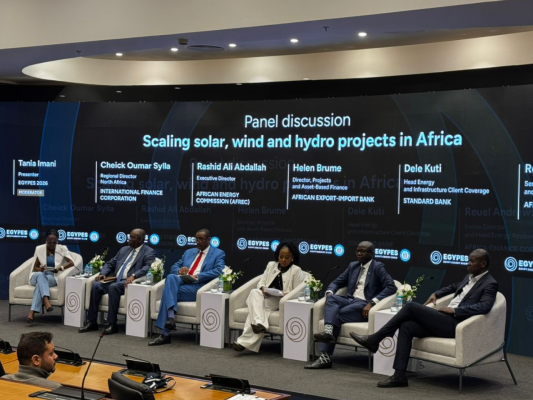
The African Energy Commission (AFREC) has reaffirmed its commitment to strengthening Africa’s downstream energy sector following its active participation at the Egypt Energy Show 2026, a leading global platform for energy dialogue.
Represented by its Executive Director, Rashid Ali Abdallah, the Commission engaged with policymakers, industry leaders and investors to advance Africa’s energy agenda across renewable energy, natural gas and strategic market positioning in an evolving global landscape. AFREC highlighted the urgent need to reduce the continent’s reliance on imported refined petroleum products despite its substantial crude oil reserves.
Speaking during a high-level panel on scaling renewable energy, Mr Abdallah underscored the importance of promoting innovation and strengthening regional value chains.
“Africa must take decisive steps to build and modernise generation capacity if we are to achieve true energy security and economic resilience. EGYPES 2026 has provided a valuable platform to engage partners and mobilise the investments needed in solar, wind and hydropower,” he said.
He further noted that the African Union has set a clear ambition to triple the share of renewable energy in the electricity mix by 2040, supported by policy alignment and continental initiatives such as the African Single Electricity Market. Mr Abdallah also highlighted plans to add 54 gigawatts of regional hydropower capacity under the Programme for Infrastructure Development in Africa, stressing that regulatory harmonisation would be essential to unlock investment.
During a ministerial roundtable convened by Egypt’s Minister of Petroleum and Mineral Resources, Karim Badawi, and attended by industry leaders, Mr Abdallah emphasised the importance of positioning Africa more effectively within global energy corridors.
“As a continent we must identify priorities including realigning regional energy trade, leveraging strategic transport routes and strengthening pricing mechanisms to enhance Africa’s competitiveness in global markets,” he said.
He added that deeper regional cooperation would be critical, noting that a more integrated African energy market — supported by harmonised fuel standards and efficient cross-border supply chains — would significantly improve resilience and competitiveness.
On the role of gas in the energy transition, AFREC Senior Policy Officer for the Oil and Gas Programme, Ocitti Bob Felix, highlighted both risks and opportunities in the current global supply environment during a panel on liquefied natural gas.
“The growing supply gap in LNG, driven by geopolitical disruptions, presents a strategic opportunity for Africa. With significant reserves in countries such as Nigeria, Algeria, Mozambique and Tanzania, the continent is well positioned to expand its role as a reliable supplier while supporting energy security and decarbonisation,” he said.
AFREC reiterated that diversification of energy sources remains essential to ensuring resilience in an increasingly volatile global market, with balanced investments across renewables, gas and infrastructure seen as key to Africa’s long-term energy security and economic growth.